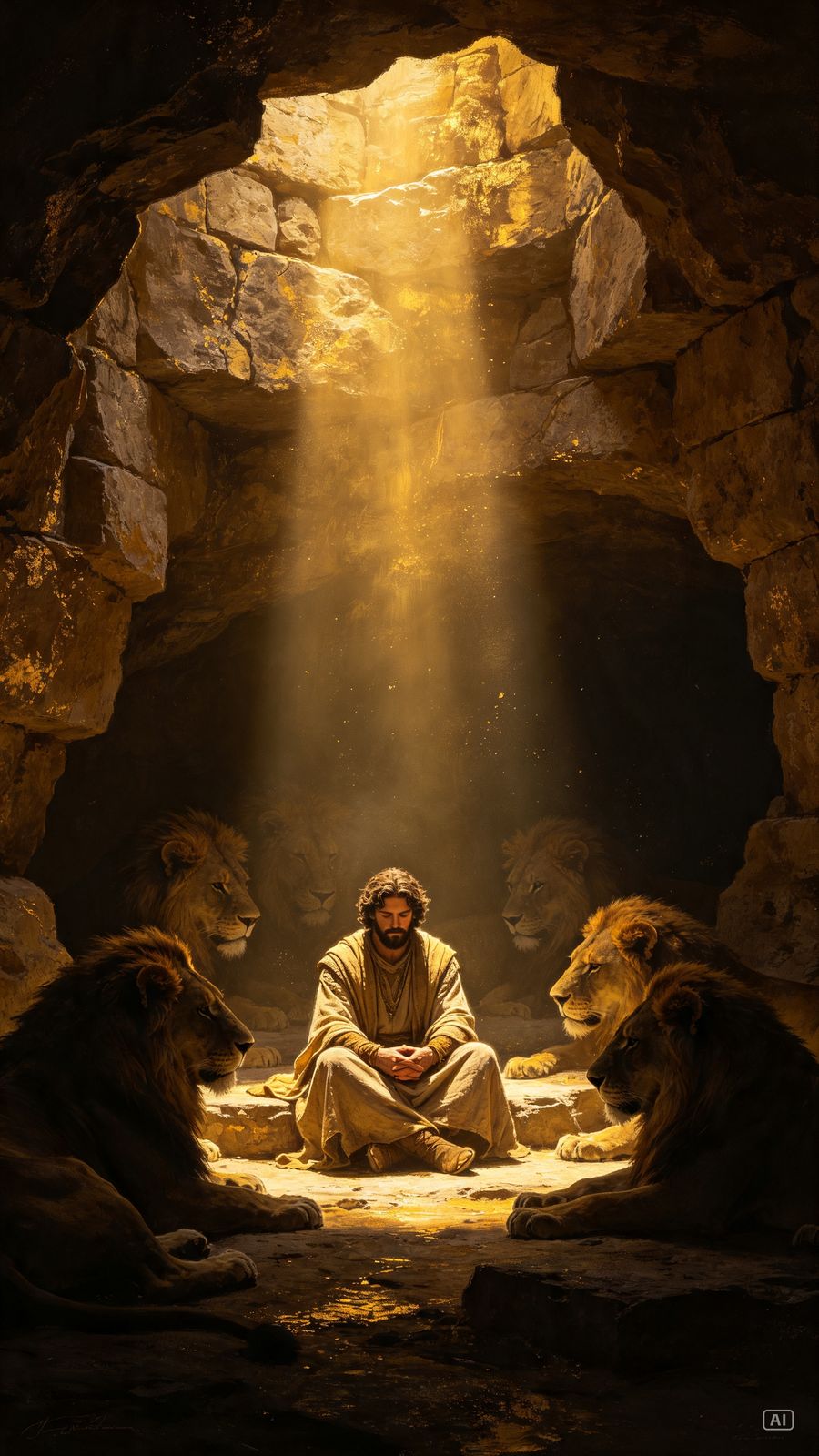
Daniel in the lions’ den is the story told in Daniel chapter 6. Under the Persian king Darius, officials jealous of Daniel persuaded the king to sign a thirty-day decree that anyone who prayed to any god or man except the king would be thrown to the lions. Daniel, by then an old man who had served in Babylon for most of his life, kept praying to God three times a day at his open window facing Jerusalem. He was arrested and thrown into the den, and the king sealed the entrance with a stone. At dawn Darius found him alive: “My God has sent his angel, and has shut the lions’ mouths” (Daniel 6:22). The accusers were thrown in instead, and Darius ordered the whole kingdom to honor the God of Daniel. The story is about faithfulness that does not change under pressure, and about a God who is able to deliver.
Few Bible stories are as well known, or as often shortened, as Daniel in the lions’ den. Most of us remember a brave man, some hungry lions and a happy ending. The chapter itself is richer and stranger than that: a jealous plot built on a law that cannot be changed, a king who spends the night fasting for the man he condemned, and a prayer habit so ordinary that it becomes the charge against him.
This guide walks through the whole of Daniel 6, scene by scene, with the text quoted word for word from the World English Bible. Then it looks at the history behind the story, the questions readers most often ask, and what the chapter has meant to Christians and Jews for over two thousand years.
Where the story is in the Bible
The story of Daniel and the lions’ den is Daniel chapter 6, all twenty-eight verses. It is the last of the six narrative chapters that open the Book of Daniel (chapters 1–6); chapters 7–12 turn to Daniel’s visions.
The Book of Daniel in brief
The book follows a young man from Judah taken to Babylon when Nebuchadnezzar besieged Jerusalem. It opens with the deportation itself:
In the third year of the reign of Jehoiakim king of Judah Nebuchadnezzar king of Babylon came to Jerusalem and besieged it. The Lord gave Jehoiakim king of Judah into his hand, with part of the vessels of the house of God; and he carried them into the land of Shinar to the house of his god. He brought the vessels into the treasure house of his god.
Daniel 1:1-2 World English Bible
Daniel and three friends, Hananiah, Mishael and Azariah (better known by their Babylonian names Shadrach, Meshach and Abednego), are trained for the king’s service. Readers often notice how closely Daniel’s life echoes Joseph’s in Egypt: another young exile who interprets a king’s dreams and rises to power. The stories that follow each put faith under pressure in a foreign court: the king’s food in chapter 1, the dream of the statue in chapter 2, the fiery furnace in chapter 3, Nebuchadnezzar’s madness in chapter 4, the writing on the wall in chapter 5, and finally the lions in chapter 6.
How old was Daniel in the lions’ den?
Much older than most paintings suggest. Daniel was a youth when he was taken to Babylon, “in the third year of the reign of Jehoiakim” (Daniel 1:1), usually dated to about 605 BC. Chapter 6 happens after Babylon has fallen to the Medes and Persians in 539 BC:
In that night Belshazzar the Chaldean King was slain. Darius the Mede received the kingdom, being about sixty-two years old.
Daniel 5:30-31 World English Bible
That places the lions’ den more than sixty years after Daniel arrived in Babylon. He was most likely in his eighties: a senior statesman with a lifetime of service behind him, not the young man of so many illustrations.
The story of Daniel in the lions’ den, scene by scene
1. A new king and a trusted official
Darius reorganizes the kingdom and puts Daniel near the top of it:
It pleased Darius to set over the kingdom one hundred twenty local governors, who should be throughout the whole kingdom; and over them three presidents, of whom Daniel was one; that these local governors might give account to them, and that the king should suffer no loss. Then this Daniel was distinguished above the presidents and the local governors, because an excellent spirit was in him; and the king thought to set him over the whole realm.
Daniel 6:1-3 World English Bible
The detail matters. Daniel is not a rebel or an outsider stirring up trouble. He is the most reliable man in the government, and the king is about to promote him over everyone else.
2. The plot: a fault they could not find
Daniel’s rivals go looking for corruption and come back empty-handed:
Then the presidents and the local governors sought to find occasion against Daniel as touching the kingdom; but they could find no occasion or fault, because he was faithful. There wasn’t any error or fault found in him. Then these men said, “We won’t find any occasion against this Daniel, unless we find it against him concerning the law of his God.”
Daniel 6:4-5 World English Bible
It is one of the most striking lines in the chapter. The only way to trap Daniel is through his faithfulness itself.
3. The decree that could not be changed
The officials come to the king with flattery and a proposal: for thirty days, no one may pray to any god or man except the king.
Then these presidents and local governors assembled together to the king, and said this to him, “King Darius, live forever! All the presidents of the kingdom, the deputies and the local governors, the counselors and the governors, have consulted together to establish a royal statute, and to make a strong decree, that whoever asks a petition of any god or man for thirty days, except of you, O king, he shall be cast into the den of lions. Now, O king, establish the decree, and sign the writing, that it not be changed, according to the law of the Medes and Persians, which doesn’t alter.” Therefore king Darius signed the writing and the decree.
Daniel 6:6-9 World English Bible
The phrase “the law of the Medes and Persians, which doesn’t alter” is the hinge of the story. The same idea of an irrevocable royal decree appears in the Book of Esther, set in the same Persian court (Esther 1:19). Once the king has signed, even he cannot undo it.
4. Daniel keeps praying
This is the heart of the chapter, and it is told in a single, unhurried sentence:
When Daniel knew that the writing was signed, he went into his house (now his windows were open in his room toward Jerusalem) and he kneeled on his knees three times a day, and prayed, and gave thanks before his God, as he did before.
Daniel 6:10 World English Bible
Daniel does not hide, protest or change anything. He prays facing Jerusalem, as Solomon had asked God to hear the prayers of exiles who turned “toward their land” and “the city which you have chosen” (1 Kings 8:48), and he prays three times a day, as the psalmist did:
Evening, morning, and at noon, I will cry out in distress. He will hear my voice.
Psalms 55:17 World English Bible
Notice the words “as he did before”. The act of faith in this story is not a dramatic gesture. It is a habit Daniel refuses to drop.
5. The accusation
The officials, who have clearly been watching, report him at once:
Then these men assembled together, and found Daniel making petition and supplication before his God. Then they came near, and spoke before the king concerning the king’s decree: “Haven’t you signed a decree that every man who makes a petition to any god or man within thirty days, except to you, O king, shall be cast into the den of lions?” The king answered, “This thing is true, according to the law of the Medes and Persians, which doesn’t alter.” Then they answered and said before the king, “That Daniel, who is of the children of the captivity of Judah, doesn’t respect you, O king, nor the decree that you have signed, but makes his petition three times a day.”
Daniel 6:11-13 World English Bible
They describe Daniel not as the king’s best minister but as “of the children of the captivity of Judah”: a foreigner, an exile, not one of us.
6. A king who tries to save him
Darius is not the villain of the story. He realizes he has been used, and he spends the rest of the day trying to find a way out:
Then the king, when he heard these words, was very displeased, and set his heart on Daniel to deliver him; and he labored until the going down of the sun to rescue him. Then these men assembled together to the king, and said to the king, “Know, O king, that it is a law of the Medes and Persians, that no decree nor statute which the king establishes may be changed.”
Daniel 6:14-15 World English Bible
But the law is the law. The king who signed the decree is trapped by it.
7. Into the den
Then the king commanded, and they brought Daniel, and cast him into the den of lions. The king spoke and said to Daniel, “Your God whom you serve continually, he will deliver you.” A stone was brought, and laid on the mouth of the den; and the king sealed it with his own signet, and with the signet of his lords; that nothing might be changed concerning Daniel.
Daniel 6:16-17 World English Bible
The king’s words as Daniel is thrown in are more than a hope. He has seen enough of Daniel’s God to say it out loud. The sealed stone means no one, in either direction, can interfere during the night.
8. The longest night
Then the king went to his palace, and passed the night fasting. No musical instruments were brought before him; and his sleep fled from him.
Daniel 6:18 World English Bible
The narrator leaves Daniel’s night in the den completely silent. We only see the palace: a king who will not eat, will not be entertained and cannot sleep.
9. Dawn at the den
Then the king arose very early in the morning, and went in haste to the den of lions. When he came near to the den to Daniel, he cried with a troubled voice. The king spoke and said to Daniel, “Daniel, servant of the living God, is your God, whom you serve continually, able to deliver you from the lions?” Then Daniel said to the king, “O king, live forever! My God has sent his angel, and has shut the lions’ mouths, and they have not hurt me; because as before him innocence was found in me; and also before you, O king, I have done no harm.”
Daniel 6:19-22 World English Bible
“Servant of the living God” is how a pagan king now addresses Daniel. And Daniel answers with the only line he speaks in the whole chapter, giving the credit to God and his angel.
Then the king was exceedingly glad, and commanded that they should take Daniel up out of the den. So Daniel was taken up out of the den, and no kind of harm was found on him, because he had trusted in his God.
Daniel 6:23 World English Bible
The narrator is careful to say why: “because he had trusted in his God.”
10. Judgment on the accusers
The chapter ends the way ancient justice often did, harshly. The men who plotted against Daniel, and their families, are thrown to the lions (Daniel 6:24). The Bible reports this without praising it; it is the king’s sentence, and the contrast with Daniel’s night is deliberate.
11. A decree for the whole kingdom
The first decree tried to make everyone pray to the king. The last one tells everyone to honor Daniel’s God:
Then king Darius wrote to all the peoples, nations, and languages, who dwell in all the earth: “Peace be multiplied to you. “I make a decree that in all the dominion of my kingdom men tremble and fear before the God of Daniel; “for he is the living God, and steadfast forever. His kingdom is that which will not be destroyed. His dominion will be even to the end. He delivers and rescues. He works signs and wonders in heaven and in earth, who has delivered Daniel from the power of the lions.”
Daniel 6:25-27 World English Bible
So this Daniel prospered in the reign of Darius, and in the reign of Cyrus the Persian.
Daniel 6:28 World English Bible
Who was Darius the Mede?
Daniel 6 calls the king “Darius the Mede”, and this is one of the most discussed questions in the whole book, because no ancient source outside the Bible names a king by that name between the fall of Babylon and the reign of Cyrus.
Scholars have proposed several explanations. Some identify him with Gubaru (Gobryas), the governor Cyrus placed over Babylon; others with Cyrus himself under another name or title; others with a Median ruler otherwise unknown. The Iranian historian Richard N. Frye, in the Encyclopaedia Iranica, notes the proposal by D. J. Wiseman that Daniel 6:28 can be read as “Darius, that is, Cyrus the Persian”, as well as the view of many critical scholars that the book is a collection of stories rather than a chronicle. Britannica summarizes the critical position as well.
What is not in doubt is the world the chapter describes: a Persian empire run through provinces and officials, a king whose sealed decrees were final, and royal courts that kept lions.
Were there really lions’ dens?
Kings in ancient Mesopotamia did keep lions. The famous reliefs from the palace of the Assyrian king Ashurbanipal at Nineveh, made around 645–635 BC and now in Room 10a of the British Museum, show captured lions released from cages for the royal hunt. The lion was the royal animal of the region; a pit or enclosure of lions at a Babylonian or Persian court fits that world closely.
The Book of Daniel describes the den as a place you are “cast into” and then “taken up out of” (Daniel 6:16, 23), closed with a stone over its mouth: most likely an underground pit with an opening at the top.
Daniel in the lions’ den: two stories, not one
Catholic and Orthodox Bibles contain a second lions’ den story, in the additions to Daniel known as Bel and the Dragon (Daniel 14 in Catholic Bibles, among the Apocrypha in many Protestant ones). There Daniel spends six days among seven lions after destroying a Babylonian idol, and the prophet Habakkuk is carried to Babylon to bring him food:
And in the den there were seven lions, and they had given to them two carcasses every day, and two sheep: but then they were not given unto them, that they might devour Daniel. Now there was in Judea a prophet called Habacuc, and he had boiled pottage, and had broken bread in a bowl: and was going into the field, to carry it to the reapers. And the angel of the Lord said to Habacuc: Carry the dinner which thou hast into Babylon to Daniel, who is in the lions’ den.
Daniel 14:31-33 Douay-Rheims
If you grew up Catholic and remember Habakkuk bringing Daniel his dinner, this is where it comes from. Protestant Bibles that follow the Hebrew canon end the Book of Daniel at chapter 12, so the only lions’ den story in them is Daniel 6.
| Daniel 6 | Daniel 14 (Bel and the Dragon) | |
|---|---|---|
| King | Darius the Mede | Cyrus the Persian |
| Why Daniel is thrown in | He keeps praying despite the decree | He destroys the idol Bel and the dragon |
| Time in the den | One night | Six days |
| Who helps him | God’s angel shuts the lions’ mouths | God keeps the lions from him; Habakkuk brings food |
| In which Bibles | All Bibles | Catholic and Orthodox Bibles; Apocrypha in many Protestant editions |
What does Daniel in the lions’ den mean?
Faithfulness is a habit before it is a crisis
The most quoted verse of the chapter is not about lions at all. It is about an old man doing what he always did: “he kneeled on his knees three times a day, and prayed, and gave thanks before his God, as he did before” (Daniel 6:10). Daniel does not become faithful in the den. The den reveals a faithfulness built over sixty years of ordinary days.
Integrity leaves your enemies nothing to use
“They could find no occasion or fault, because he was faithful” (Daniel 6:4). The chapter is also about work: Daniel served a foreign government so honestly that the only charge anyone could bring against him was his devotion to God.
God is able to deliver, and Daniel trusts him either way
Darius asks the question the whole book asks: “is your God, whom you serve continually, able to deliver you?” (Daniel 6:20). The answer in chapter 6 is yes. Daniel’s friends, facing the furnace in chapter 3, had already said how faith holds when the outcome is not known:
If it happens, our God whom we serve is able to deliver us from the burning fiery furnace; and he will deliver us out of your hand, O king. But if not, let it be known to you, O king, that we will not serve your gods or worship the golden image which you have set up.”
Daniel 3:17-18 World English Bible
That “but if not” is the other half of the lions’ den. Daniel went in without a promise that he would come out.
The story in the New Testament
The Letter to the Hebrews lists the heroes of faith who “stopped the mouths of lions” (Hebrews 11:33), a clear reference to Daniel. The early Christians, who faced lions of their own in Roman arenas, painted Daniel between two lions in the catacombs: a picture of rescue, and of hope beyond it.
How to read Daniel 6 with a group or your family
A few questions that work well for a small group, a Bible study or a conversation at home:
- Daniel’s rivals could only accuse him “concerning the law of his God”. What would someone find if they looked for a fault in your work?
- Daniel prayed “as he did before”. What small, daily habit of faith would you want to keep even under pressure?
- Darius loved Daniel but was trapped by his own decree. Have you ever made a commitment you later regretted?
- Why do you think the narrator tells us about the king’s night, and nothing about Daniel’s?
- Read Daniel 3:17-18 next to Daniel 6:22. How is trust different when you do not know the outcome?
For children, the heart of the story fits in one sentence: Daniel kept talking to God even when it was dangerous, and God took care of him.
Watch the story: Daniel in the lions’ den video series
If you would rather see the story than read it, Daniel: Faithful in Babylon is our eight-episode series on the Book of Daniel, from the exile in Jerusalem to the night in the den. Each episode is a few minutes long, and every line of Scripture in it is quoted word for word, with the passage one tap away. (Bible Saga is our app: we are recommending our own work, and we think it is the most faithful way to watch this story on a phone.)
Frequently asked questions
Where is the story of Daniel in the lions’ den in the Bible?
It is in Daniel chapter 6, verses 1 to 28. Catholic and Orthodox Bibles also contain a second lions’ den story in Daniel 14 (Bel and the Dragon), which is part of the Apocrypha in many Protestant editions.
Why was Daniel thrown into the lions’ den?
Because he kept praying to God after King Darius signed a thirty-day decree that anyone who prayed to any god or man except the king would be thrown to the lions. The decree was a trap set by officials who were jealous of Daniel and could find no other fault in him.
How long was Daniel in the lions’ den?
One night. He was thrown in at the end of the day, the entrance was sealed with a stone, and the king came to the den very early the next morning (Daniel 6:16-19). In the separate story of Bel and the Dragon, Daniel stays six days among seven lions.
How old was Daniel when he was in the lions’ den?
Probably in his eighties. He was taken to Babylon as a youth around 605 BC, and the lions’ den happens after the fall of Babylon in 539 BC, more than sixty years later.
What does “the law of the Medes and Persians” mean?
It describes a royal decree that could not be changed once it was signed and sealed, even by the king who issued it. That is why Darius, who wanted to save Daniel, could not simply cancel the order (Daniel 6:8, 12, 15). The same idea appears in the Book of Esther.
Who shut the lions’ mouths?
Daniel says it himself: “My God has sent his angel, and has shut the lions’ mouths, and they have not hurt me” (Daniel 6:22). The Letter to the Hebrews later lists people who, through faith, “stopped the mouths of lions” (Hebrews 11:33).
What is the lesson of Daniel in the lions’ den?
That faithfulness is built in ordinary days and holds under pressure, that honest work leaves opponents nothing to use against you, and that God is able to deliver those who trust him. Many Christians also read it alongside Daniel 3:18: trust in God does not depend on knowing how things will end.
Is there a movie or video of Daniel in the lions’ den?
Yes. Bible Saga tells it in Daniel: Faithful in Babylon, a series of eight short cinematic episodes that quote Scripture word for word. There are also older feature films and many animated versions for children.
Sources
- The Bible: Daniel 1, 3, 5, 6 and Psalm 55, 1 Kings 8, Esther 1, Hebrews 11, quoted from the World English Bible (public domain); Daniel 14 quoted from the Douay-Rheims (public domain).
- Richard N. Frye, “Darius the Mede”, Encyclopaedia Iranica. iranicaonline.org
- “Biblical literature: Daniel”, Encyclopaedia Britannica. britannica.com
- “Assyria: lion hunts”, Room 10a, British Museum. britishmuseum.org